
A real life experience: no purpose, no party.
For almost one decade I was deeply convinced I authentically wanted to move up the ladder in the industry, in order to show others I could make it and to get good money as well. I just thought that was the game to play and, of course, to win.
I used to be a gifted and highly disciplined girl, a graduated early with honor young woman fully committed while working for a big company in my home country. However, something was wrong. At that time I did not know what it was, but I often felt like I was not belonging to all that even if it was impossible for me to think that the path I was pursuing was not the perfect one.
I was unhappy and so the question is: why I was that sure it was the perfect path for me to follow? why I thought no other option could work better?
It took me some years and many struggles to answer the questions above, but when I got clarity about the impact I really wanted to have as a professional, I immediately realized why I could not figured it out: my former career was fully resonating with the standards I’ve always learnt to consider as the “proper measures of success”. Being a high performer, my only option was to follow (and eventually exceed) the standards. I could not accept that something considered to be perfect by the society as a whole could be even painful for me. However, this was actually the case. And I also learnt that the problem was not me, but the standards – and the purpose behind these, or maybe the lack of it.
First step first to choose the direction and move forward was to dive deep to find my professional purpose. I knew few things I was passionate about and I also was quite good at: enabling people to feel confident and at ease in the workplace, to learn new stuff, to up-skill their selves, to embrace the change and to get the maximum value from their experience at work.
What next? I started working within the Transformation & Change Management space for international consulting firms, and I still work in the field – and I loved it, and I still love it. I also got an international certification as career coach, because I think this is a very powerful tool for people to discover their professional inner purpose and to pursue fulfilling careers.
Story’s takeaway: make your purpose matter!
I was struggling in my former career because I did not choose it looking at my inner purpose. I just followed an idea of “success” based on a set of standards that used to be (and actually still are) the commonly accepted ones.
As a direct consequence that career was not meaningful enough for me, which is the reason why I felt so uncomfortable in pursuing it. A not meaningful career is a not sustainable one too.
Why is the purpose so important for people to feel fulfilled at work?
Because, as human beings, we are “hardwired to seek meaning” and a lack of meaning is seen as a serious psychological deprivation, especially in this post-modern society continuously bringing the pressure to live “authentically”.
Purposeful choices lead to careers that are meaningful for the person that is pursuing that specific journey, rather than a different one. And given the importance of meaningfulness for human motivation and well-being, it is crucial for people to firstly acknowledge their purpose in a way to achieve an authentically fulfilling career.
Why is the purpose at work more important for women than for men?
Because till day 1 of their life women tend to define themselves in relation to gender stereotypes, whether rejecting stereotypically masculine approaches because they feel inauthentic or rejecting stereotypically feminine ones for fear that they convey incompetence.
Doing so women ultimately de-focus themselves on behaving in ways that advance the purposes for which they stand. In fact people who focus on how others perceive them are less clear about their goals, less open to learning from failure and less capable of self-regulation.
In particular, women keen to find the perfect balance between “being respected/being liked” trade-off spend time and energy on managing these perceptions, ultimately diminishing the emotional and motivational resources available for larger purposes.
This is what happens in practice:
- Firstly women are attracted by what is commonly considered the standard of success. Stereotype in action: what is broadly considered to be successful, right, smart, rewarding, cool is what I want to pursue – and it is male-determined of course.
- Secondly women start rejecting stereotypically feminine approaches in order to survive in masculine-driven company culture. Stereotype in action: if I want to play that game, I need to be like a men.
Any women who experienced something like that is perfectly aware how much is painful.
Anchoring in purpose enables women to redirect their attention toward shared goals and to consider who they need to be and what they need to learn in order to achieve those goals. This is what happen to me as well.
After deep self-reflections I discovered my personal purpose was not aligned with the work I had chosen in the first place and, even if it was hard at the beginning even to accept, I succeeded in finding my way just fully focusing on my purpose. And the rest is history.
What happens when women focus themselves on their authentic professional purpose?
When women focus themselves on their authentic professional purpose…magic happens!
In fact a strong and grounded purpose enables women to take bold steps, like career shifts whenever they feel it’s appropriate, or it provides them with daily motivation to face all challenges they tackle in case they are pursuing the career they really want.
They radically change their perspective and behaviors in many different spaces like:
- LEADERSHIP STYLE
- DEFINITION OF SUCCESS
- CAREER PATHWAY
How do you find your purpose at work?
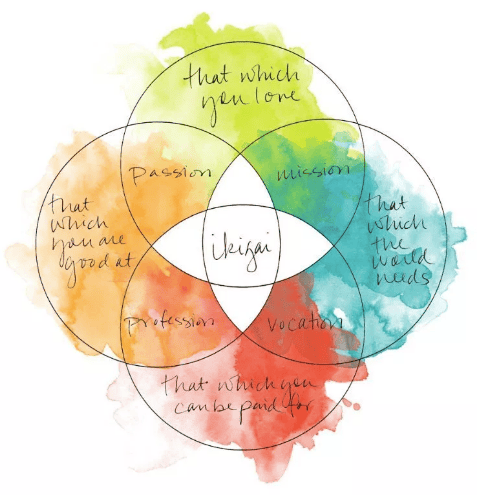
There are many self-reflection methods and tools to help you find your purpose at work, however my favorite one is based on a wonderful Japanese concept called ikigai. It is a quite holistic approach, given that ikigai literally means “reason for being”.
The ikigai is the intersection of four dimensions: what you love, what you are good at, what the world needs and what you can be paid for.
Discover more about ikigai and have a try yourself making use of the templates you can find here, or get in touch if you want to be guided in discovering your authentic professional purpose.

